Stop Hardcoding Prompts in Your Codebase
June 6, 2026
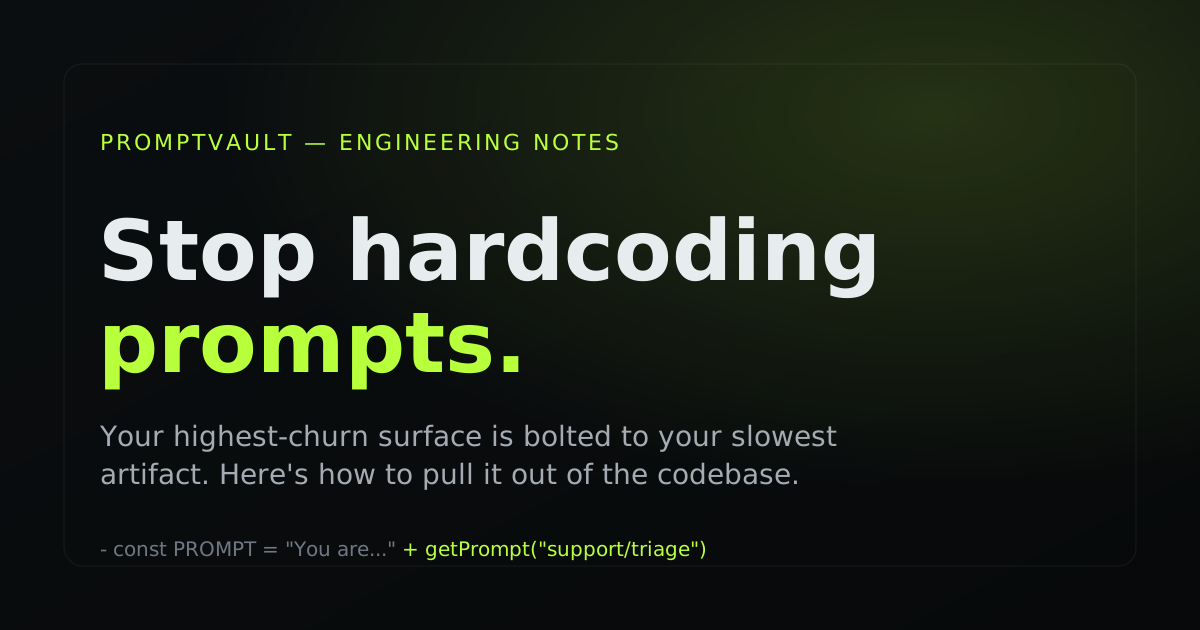
Open almost any AI feature shipped in the last two years and you'll find the same thing: a multi-paragraph prompt living as a string constant, three folders deep, next to the code that calls the model. It works in the demo. Then the feature hits production, the prompt needs its fortieth tweak, and that innocent-looking string turns into the most expensive line in your repo. The scale of this is new — 1.13 million public repositories now depend on generative-AI SDKs, up 178% year over year (GitHub Octoverse, 2025). Most of them hardcode the prompt. Here's why that's a problem, and how to fix it without a rewrite.
Key Takeaways
- Gen-AI SDK adoption in public repos jumped 178% in a year, and most projects still embed prompts as source constants (GitHub Octoverse, 2025).
- A hardcoded prompt couples your fastest-changing surface to your slowest-moving artifact — the deploy.
- You can extract prompts in an afternoon: fetch by key at runtime instead of importing a constant.
What's actually wrong with a hardcoded prompt?
Nothing — until it changes. And prompts change constantly. The problem is structural: a prompt is the highest-churn surface in an AI product, and hardcoding bolts it to the slowest-moving artifact you own, the deploy. That mismatch is where the pain comes from. It matters more now that 90% of technology professionals report using AI at work, and DORA found AI adoption tends to lower delivery stability unless teams add real guardrails (DORA, 2025).
Look at what the typical version actually is:
SUPPORT_PROMPT = """You are a support agent for Acme. Be concise.
Never promise refunds. If the user is angry, escalate to a human..."""

def triage(ticket):
    return llm.complete(SUPPORT_PROMPT + ticket.body)
That string carries product policy, tone, and edge-case handling — the stuff that gets revised weekly. But it's compiled into your bundle like a sorting algorithm that hasn't changed since 2019. Every edit to it now inherits the full weight of a code change.
What breaks when the prompt lives in code?
Four things break, and they compound. The headline cost is the redeploy tax: a thirty-second wording fix has to ride your entire build-and-release pipeline before it reaches a user. But the quieter costs hurt more over time — no rollback, the wrong people locked out, and drift you can't see.
| Failure mode | What it looks like in practice |
|---|---|
| Redeploy tax | A one-word fix waits hours for the next release window |
| No rollback | Bad output at 2 a.m. means a hotfix deploy, not a one-click revert |
| Locked-out experts | The PM who read every angry ticket can't touch the prompt that serves them |
| Invisible drift | The string is edited dozens of times with no diff, until nobody knows why quality slid |
This isn't a fringe concern. The adoption-versus-maturity gap is enormous — 72% of organizations now use generative AI regularly, up from 33% a year earlier, yet only about 1% describe their rollouts as mature (McKinsey, 2025). A lot of that missing maturity is exactly this: teams can write a prompt, but they can't operate one.
Our take: the worst failure mode here is the invisible one. A bad deploy throws an error you'll notice. A slowly drifting prompt just quietly gets worse, and without version history there's nothing to diff and nothing to roll back to.
How do you get prompts out of your code?
You replace the import with a lookup. Instead of compiling the prompt into your bundle, you give it a stable key and fetch the current version at runtime from a prompt store. The code stops caring what the prompt says — it only knows which prompt to ask for.
The same function, decoupled:
def triage(ticket):
    prompt = prompts.get("support/triage")  # resolves to the live version
    return llm.complete(prompt.render(body=ticket.body))
Four steps get you there, and none of them require a rewrite:
- Give each prompt a key.
support/triage,onboarding/welcome— a stable identifier your code references instead of a string literal. - Move the text to a store. Pull every prompt out of source into a dedicated registry that versions each change.
- Fetch at runtime, with a cache. Resolve the key to the live version on call, cached so you're not adding a network hop to every request. (Stale-while-revalidate keeps it fast without going stale.)
- Promote, don't deploy. Point production at a new version through the registry — your application binary never changes.
The payoff is immediate: the prompt now moves at the speed of config, and your code ships on its own, much slower clock. That's the whole separation feature flags brought to releases, applied to the most-edited surface in your product.
Won't I lose version control and review?
This is the right objection, and the answer is no — you lose a bad version of them and gain a better one. A prompt as a string constant gives you Git history, sure, but it's coupled to your deploy cycle, invisible to non-engineers, and impossible to evaluate before shipping. Pulling prompts into a registry trades that for prompt-native versioning: a numbered history, a diff, an author, and an eval gate before anything reaches users.
That gate matters because quality, not cost, is what teams actually struggle with. In LangChain's 2025 survey of agent builders, "quality" was the single most-cited barrier to shipping to production, named by 32% of respondents — well ahead of cost or safety (LangChain, 2025). You don't close a quality gap by editing a string and hoping. You close it by scoring each prompt version against real examples before promoting it — the same discipline a test suite gives your code. For the full workflow, our guide to prompt versioning best practices covers the mechanics.
When should a prompt stay in code?
When the change isn't really about words. If a prompt edit forces a matching code change to stay correct — a new output schema your parser depends on, a tool definition, a structural rewrite wired to application logic — version it with that code. Those aren't config changes that happen to involve text; they're code changes that happen to involve a prompt.
The test is simple. If the change is just wording, behavior, tone, or policy, it's config — pull it out. If the change breaks your code unless the code changes too, ship them together. The honest answer is that most day-to-day prompt work falls squarely in the first bucket, which is exactly why that bucket deserves better tooling than a string literal.
Frequently asked questions
Isn't fetching the prompt at runtime going to slow down every request?
Not if you cache it. The live version is resolved once and held in memory, with stale-while-revalidate refreshing it in the background — so steady-state latency is effectively zero. This matters because performance quality is already the top production barrier for 32% of teams (LangChain, 2025); adding a slow lookup would defeat the purpose.
Is a Git repo not enough to manage prompts?
Git tracks history well, but it chains every prompt edit to your deploy pipeline and offers no evals, no environment promotion, and no access for non-engineers. With AI adoption correlated with reduced delivery stability absent strong guardrails (DORA, 2025), prompts need a workflow built for how often they actually change.
How often do prompts really change?
Often enough that friction compounds fast. As inference costs fall — roughly 10x cheaper per year for equivalent quality (a16z, 2024) — teams iterate more, not less. Cheap tokens invite constant tuning, which is precisely the case for making each change a fast, reversible config update instead of a deploy.
Does this work for a small team or solo project?
Yes, and arguably it helps sooner. Smaller teams feel the redeploy tax most because every release competes with feature work. Decoupling prompts lets one person fix output quality in seconds without interrupting a build — the benefit doesn't wait for scale.
The line to draw
Stop shipping your most-edited surface like it's source code. A hardcoded prompt felt fine when AI was a prototype; in production it quietly taxes every change you make. Give each prompt a key, move the text to a versioned store, fetch it at runtime, and promote new versions without touching your binary. The refactor is small. The change in how fast you can fix things is not.
That's the problem we built PromptVault to solve — a single versioned registry for your prompts, with evals and one-click rollout built in. For the team workflow around it, see prompt management for teams, or browse the rest of the PromptVault blog.